
When choosing an espresso machine, you may notice that portafilters come in different sizes, most commonly 51mm, 54mm and 58mm.
Does a larger portafilter make better espresso?
Not necessarily. Portafilter size mainly affects the shape of the coffee puck, machine design, accessory compatibility and brewing workflow. Espresso quality still depends more on the grinder, coffee beans, temperature stability and puck preparation.
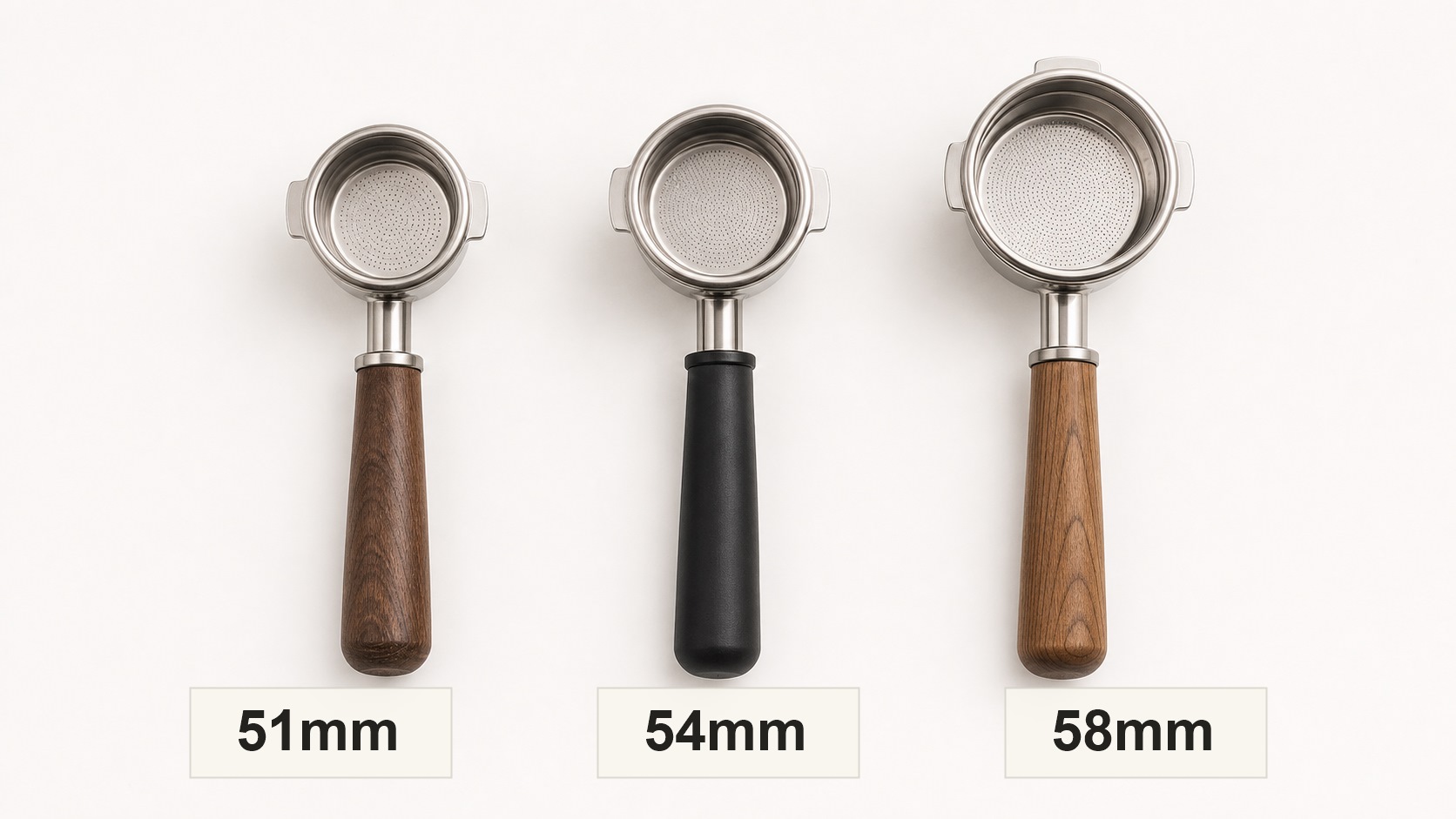
Different portafilter sizes create different coffee-puck shapes and brewing characteristics.
What Does Portafilter Size Mean?
The size usually refers to the approximate diameter of the filter basket inside the portafilter.
It does not refer to the length of the handle or the outside width of the complete portafilter.
Common sizes include:
| Size | Common Applications | Main Characteristics |
|---|---|---|
| 49–51mm | Compact home and manual machines | Narrower and deeper coffee puck |
| 53–54mm | Home and selected professional machines | Balanced size and puck depth |
| 57mm | Brand-specific espresso machines | Less common accessory system |
| 58mm | Commercial and prosumer machines | Wide accessory availability |
The exact dimensions may vary between brands. Therefore, a 54mm or 58mm portafilter is not always compatible with every machine using the same nominal size.
How Size Affects the Coffee Puck
With the same amount of coffee, a smaller basket creates a narrower and deeper puck, while a larger basket creates a wider and shallower puck.
For example:
A 51mm basket usually produces a deeper coffee bed.
A 54mm basket offers a balance between depth and surface area.
A 58mm basket spreads the coffee over a wider area.
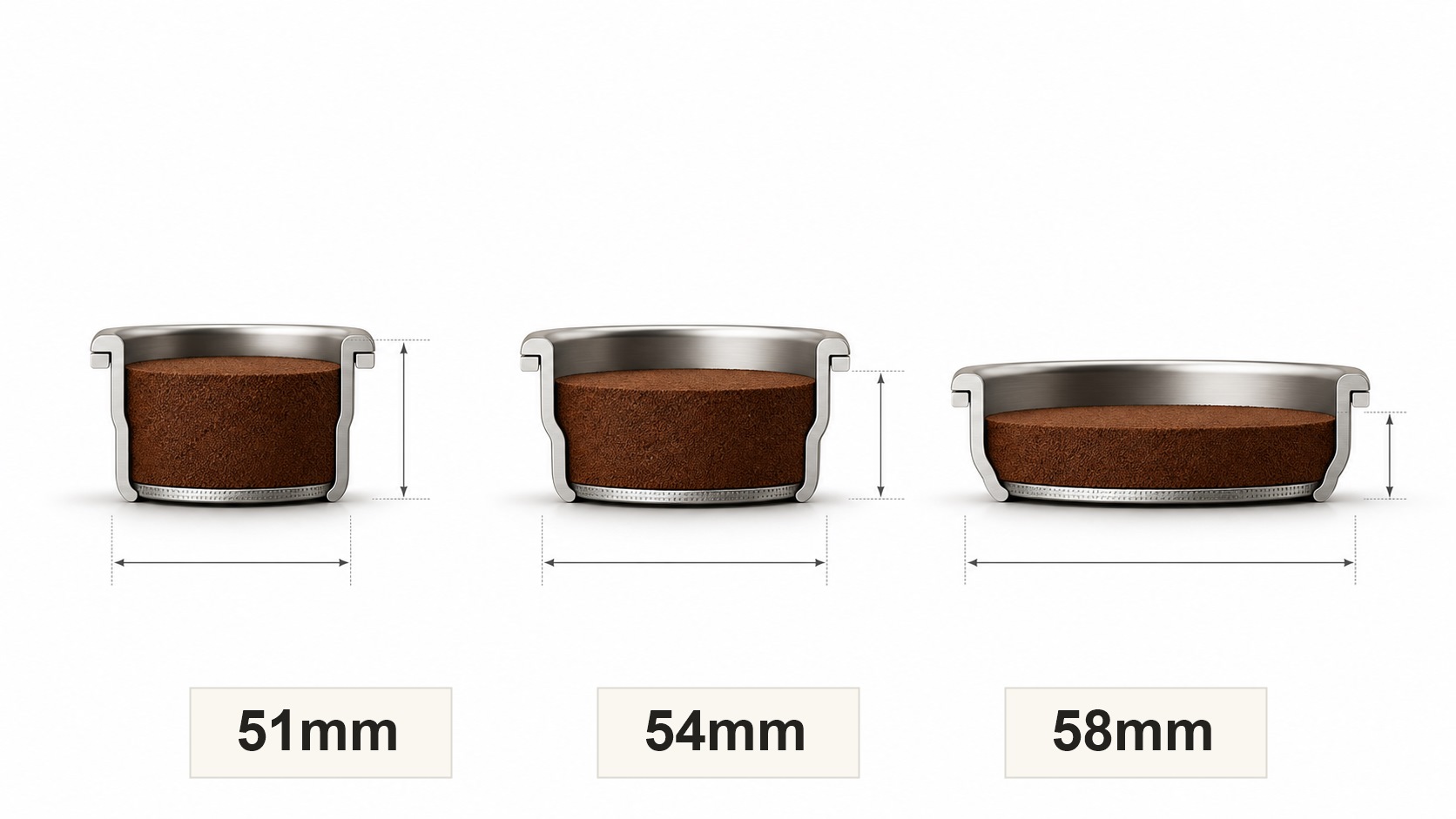
The same coffee dose forms a deeper puck in a smaller basket and a wider puck in a larger basket.
Puck shape can influence water flow, grind settings and extraction resistance. However, basket design, grind size, dose and distribution remain equally important.
51mm Portafilters
The 51mm format is commonly found on compact home espresso machines.
Its smaller diameter allows manufacturers to design a lighter and more compact brewing group. With the same coffee dose, it also creates a relatively deep puck.
Advantages
Compact machine design
Suitable for everyday home use
Deeper coffee puck
Lightweight and easy to handle
Limitations
Fewer precision accessories
Compatibility varies between brands
Less space for distributing larger coffee doses
A 51mm portafilter can still produce excellent espresso when used with a good grinder and proper brewing technique.
54mm Portafilters
The 54mm size is widely used in home espresso machines and is also found in some professional systems.
It offers a practical balance between the compact size of 51mm and the wider brewing area of 58mm.
Advantages
Good balance between puck depth and surface area
Suitable for standard double-shot doses
More compact than many 58mm systems
Good accessory availability for popular brands
Limitations
Many accessories are brand-specific
Not all 54mm portafilters are interchangeable
Smaller aftermarket range than 58mm
The 54mm format should not be considered less professional. Its performance depends on the complete brewing system, not simply its diameter.
58mm Portafilters
The 58mm format is widely used in commercial and prosumer espresso machines.
Its main advantage is the large accessory ecosystem, including precision baskets, tampers, dosing funnels, puck screens and bottomless portafilters.
Advantages
Wide range of compatible accessories
Common in professional espresso equipment
Suitable for different basket capacities
Convenient for advanced coffee preparation
Limitations
Requires careful and even coffee distribution
Portafilters and group heads may be heavier
Machines are often larger
Same-size portafilters may still use different locking tabs
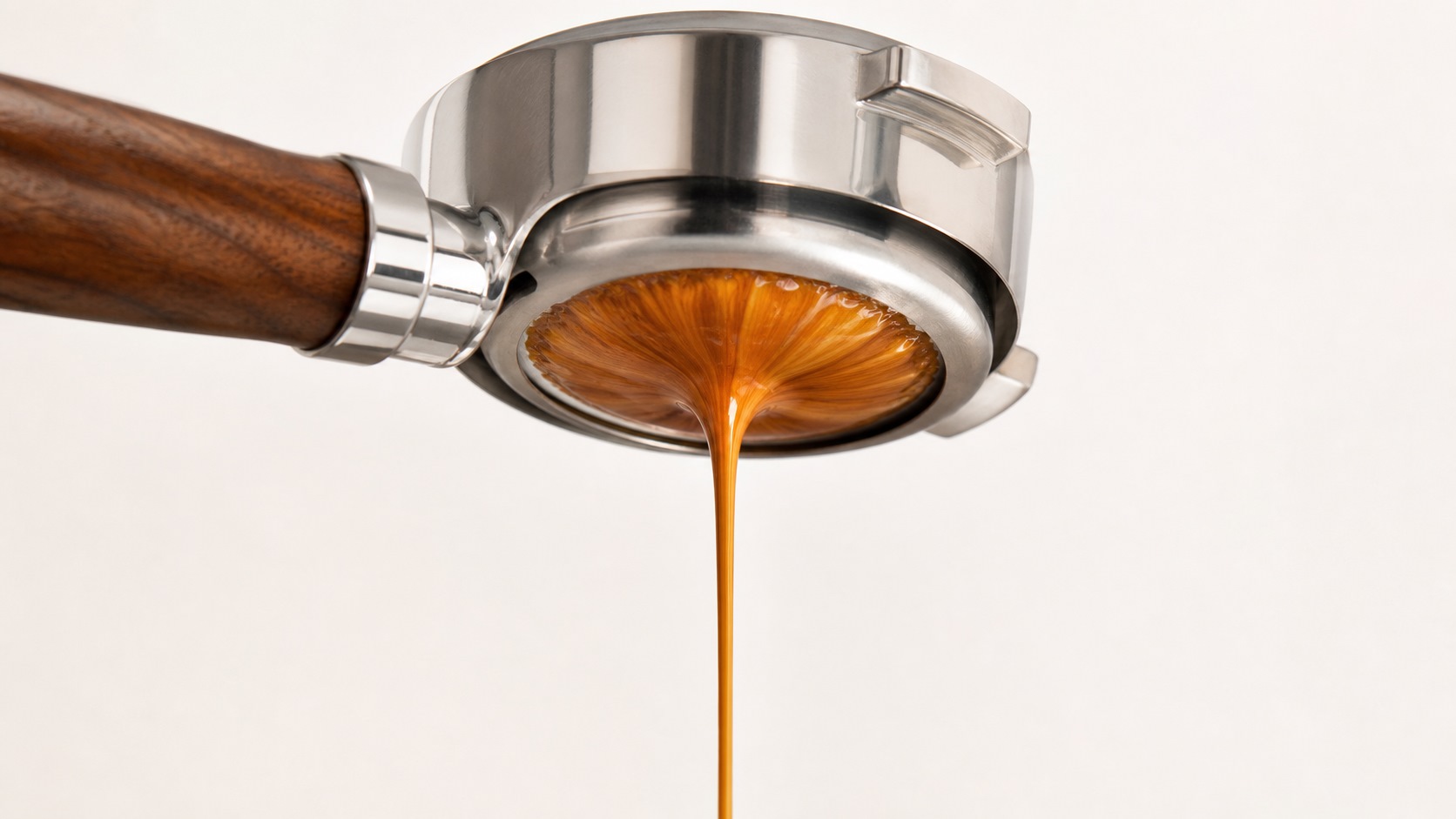
A bottomless portafilter helps users observe extraction and identify uneven flow or channeling.
Does a Larger Portafilter Hold More Coffee?
Not always.
Basket capacity depends on both diameter and depth. A deep 54mm basket may hold more coffee than a shallow 58mm basket.
When selecting a basket, check the recommended coffee dose rather than relying only on the portafilter diameter.
Does 58mm Make Better Espresso?
No portafilter size automatically produces better espresso.
A 58mm system offers more accessories and greater flexibility, but a 51mm or 54mm machine can produce equally good coffee when it has:
Stable brewing temperature
A well-designed filter basket
A capable grinder
Correct grind size
Even coffee distribution
Consistent dose and yield
The portafilter is only one part of the complete espresso system.
Why Same-Size Portafilters May Not Fit
Even when two portafilters are both marked as 58mm, they may not fit the same espresso machine.
Compatibility also depends on:
Locking-tab number
Tab thickness
Tab position
Group-head design
Gasket thickness
Basket-rim shape
Always confirm the machine model before purchasing a replacement or bottomless portafilter.
Which Size Should You Choose?
For casual home use, a 51mm or 54mm system is usually sufficient.
For coffee enthusiasts who want more precision baskets and accessories, 58mm offers greater flexibility.
For existing machine owners, the correct choice is always the size and locking system designed for the specific machine.
Final Thoughts
Portafilter size affects coffee-puck geometry, machine size and accessory compatibility, but it does not directly determine espresso quality.
In simple terms:
51mm: compact and suitable for home use
54mm: balanced and versatile
58mm: widely used in professional equipment with more accessory options
The best portafilter is not necessarily the largest one. It is the one that works correctly with the machine, grinder and coffee recipe.