

The burr set is one of the most important components inside a coffee grinder. Flat burrs and conical burrs process coffee in different ways, influencing grind distribution, workflow, motor requirements and the flavor balance in the cup. This guide explains the practical differences without treating either design as universally superior.
Why Burr Geometry Matters
Unlike blade grinders, burr grinders crush and cut coffee between two precisely shaped surfaces. The distance between those surfaces determines the target grind size. However, the final result is also affected by burr diameter, tooth design, alignment, rotational speed, motor torque, bean condition and the grinder’s internal discharge path.
For this reason, “flat versus conical” should be viewed as a starting point rather than the only measure of grinder quality. A well-engineered conical burr grinder can outperform a poorly aligned flat burr grinder, and the reverse is equally true.
How Flat Burr Grinders Work
A flat burr set normally uses two ring-shaped burrs positioned parallel to each other. One burr remains stationary while the other rotates. Coffee enters near the center, moves outward through progressively finer cutting zones and exits around the outer edge.
This horizontal grinding path can produce a relatively narrow and controlled particle distribution when the burrs are accurately aligned. Flat burr systems are therefore common in espresso-focused grinders, cafés and applications where repeatability and fine adjustment are important.
How Conical Burr Grinders Work
A conical burr set uses a cone-shaped inner burr inside a ring-shaped outer burr. Beans fall through the space between the two surfaces and are gradually reduced as they move downward. Gravity naturally assists the feeding process.
Because of this geometry, conical burr grinders can often operate at lower rotational speeds and with efficient bean feeding. They are widely used in home grinders, automatic coffee machines and commercial designs that prioritize compact construction, quieter operation and a forgiving workflow.
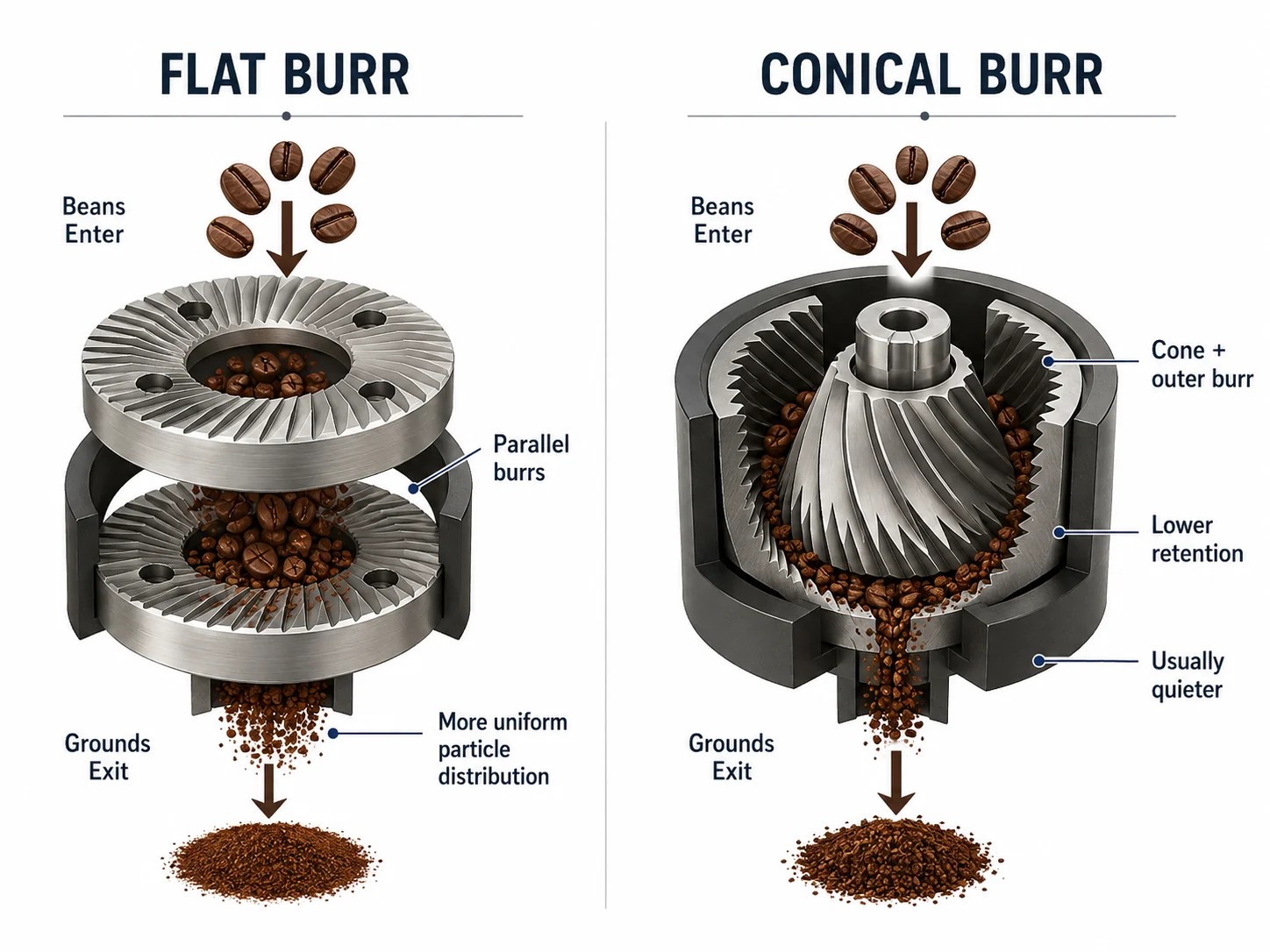
Important: Burr shape alone does not guarantee lower retention, less heat or better consistency. These results depend on the complete grinder design, including the chamber, chute, anti-static system, RPM, alignment and burr tooth geometry.
Flat Burr vs Conical Burr: Key Differences
| Factor | Flat Burr | Conical Burr |
|---|---|---|
| Grinding structure | Two parallel ring-shaped burrs | One cone-shaped inner burr and one outer ring burr |
| Coffee flow | From the center toward the outer edge | From the top downward through the burr gap |
| Particle distribution | Often designed for a tighter, more uniform distribution | Often produces a broader distribution with useful fines |
| Flavor tendency | Often associated with clarity and separation of flavors | Often associated with body, sweetness and a blended flavor profile |
| Motor and RPM | Frequently uses higher RPM or greater motor power | Can grind efficiently at lower RPM due to gravity-assisted feeding |
| Noise | Can sound sharper or louder, depending on motor and housing | Often perceived as quieter, especially in low-RPM home grinders |
| Typical applications | Espresso bars, high-precision dosing and specialty coffee | Home use, automatic machines and multi-purpose brewing |
1. Grind Consistency and Particle Distribution
Flat burrs are often selected when the target is a more concentrated particle-size distribution. In practical terms, this can make extraction easier to control and may help produce a cleaner separation between acidity, sweetness and aroma.
Conical burrs frequently create a wider range of particle sizes, including a controlled amount of fine particles. Those fines can increase resistance during espresso extraction and contribute to a fuller body. This does not automatically mean conical burrs are less precise; many conical designs are engineered specifically to create a desirable distribution for espresso or all-purpose brewing.
2. Flavor in the Cup
In general, coffee professionals often describe flat burr grinders as producing greater clarity, cleaner acidity and more distinct flavor separation. This can be attractive for light-roasted specialty coffees where the goal is to highlight floral, fruit or origin-specific notes.
Conical burr grinders are often associated with more body, rounded sweetness and a more blended flavor presentation. This can work well for traditional espresso, medium or dark roasts and milk-based beverages.
These are tendencies rather than fixed rules. Burr coating, tooth pattern, roast level, brewing recipe and grinder calibration can change the result significantly.
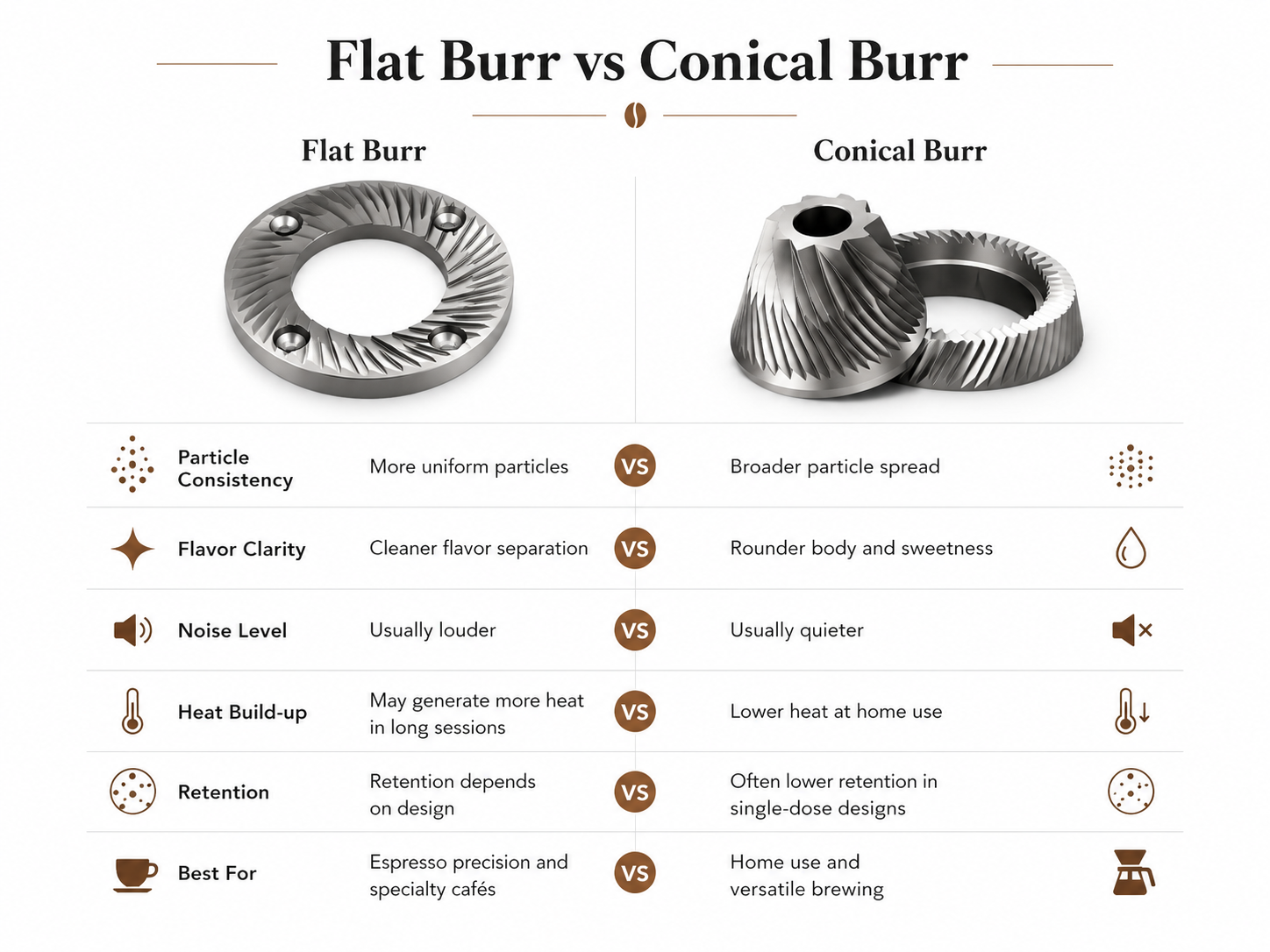 Flat burr designs are often chosen for clarity and consistency, while conical burr designs are popular for a forgiving and home-friendly workflow.
3. Speed, Heat and Motor Requirements
Flat burrs may require higher rotational speed or more motor torque to move coffee efficiently through the horizontal cutting path. Higher RPM can increase grinding speed, but it also makes motor design, ventilation and duty cycle more important.
Conical burrs use gravity to help move beans downward. This allows many grinders to operate at lower RPM while still maintaining a practical output. Lower RPM may reduce noise and heat generation, although the actual temperature rise depends on grinding time, burr size, motor efficiency and continuous workload.
4. Retention and Cleaning
Retention is the amount of ground coffee left inside the grinder after grinding. It is not determined only by whether the burr is flat or conical. The grinding chamber, declumper, exit chute, static control and dosing system usually have a greater effect.
Some conical grinders have a compact vertical path that supports low retention. However, many modern flat burr single-dose grinders also achieve extremely low retention through optimized chambers and direct-exit designs. For commercial hopper grinders, regular cleaning remains essential regardless of burr shape.
5. Adjustment and Daily Workflow
Flat burr espresso grinders are often paired with precise stepless adjustment systems. Small changes can have a noticeable effect on shot time, which is useful for dialing in but may demand more attention from the operator.
Conical burr grinders can feel more forgiving when switching between different beans or brew methods. They are common in domestic grinders and bean-to-cup machines where ease of use, compact size and stable feeding are priorities.
Which Burr Type Should You Choose?
Choose a Flat Burr Grinder When:
You want clear flavor separation and repeatable espresso results.
You mainly use light to medium specialty roasts.
You need high-volume café performance or fine grind adjustment.
You are comfortable dialing in the grinder more precisely.
Choose a Conical Burr Grinder When:
You prefer fuller body and a rounded flavor profile.
You want a quieter and more compact home grinder.
You use different brew methods or automatic coffee equipment.
You value an easy, forgiving daily workflow.
What Buyers Should Check Beyond Burr Shape
For distributors, brands and OEM/ODM buyers, burr geometry is only one part of product evaluation. A complete grinder assessment should also include:
Burr material and coating: hardened steel, stainless steel or coated burrs affect wear resistance and service life.
Burr diameter: larger burrs can improve grinding speed and thermal stability, but require suitable motor power.
Alignment: poor alignment can create uneven particles even with high-quality burrs.
Adjustment system: stepped or stepless control should match the intended user and brewing method.
Retention and static control: chamber design, declumpers and anti-static technology affect dosing accuracy and cleanliness.
Duty cycle: home and commercial grinders require different motors, cooling systems and structural durability.
Frequently Asked Questions
Are flat burr grinders always better for espresso?
No. Flat burr grinders are popular for precise espresso, but many high-quality conical burr grinders also produce excellent espresso. The complete burr design, alignment and adjustment system matter more than shape alone.
Do conical burr grinders produce more fines?
Many conical burr sets produce a broader particle distribution, but this varies by burr geometry. Some fines can be beneficial for body and espresso resistance.
Which grinder is quieter?
Conical burr grinders are often quieter because many operate at lower RPM. Motor type, housing, gearbox and insulation can be equally important.
Which burr type is easier to maintain?
Maintenance depends mainly on access to the burr chamber, retention, chute design and calibration method. Both types require regular cleaning and timely burr replacement.
Final Conclusion
Flat burr grinders are commonly chosen for clarity, consistency and precise espresso control. Conical burr grinders are widely valued for body, efficient feeding, compact construction and a forgiving workflow. Neither design is automatically better for every user.
The best grinder is the one whose burr geometry, motor, adjustment system and internal structure are engineered around the intended brewing method and target market.
Develop Your Coffee Grinder Product with Kenveo
Kenveo provides OEM/ODM appliance solutions for coffee equipment brands, importers and distributors. Contact us to discuss grinder specifications, product positioning, branding and market requirements.
Contact Kenveo